

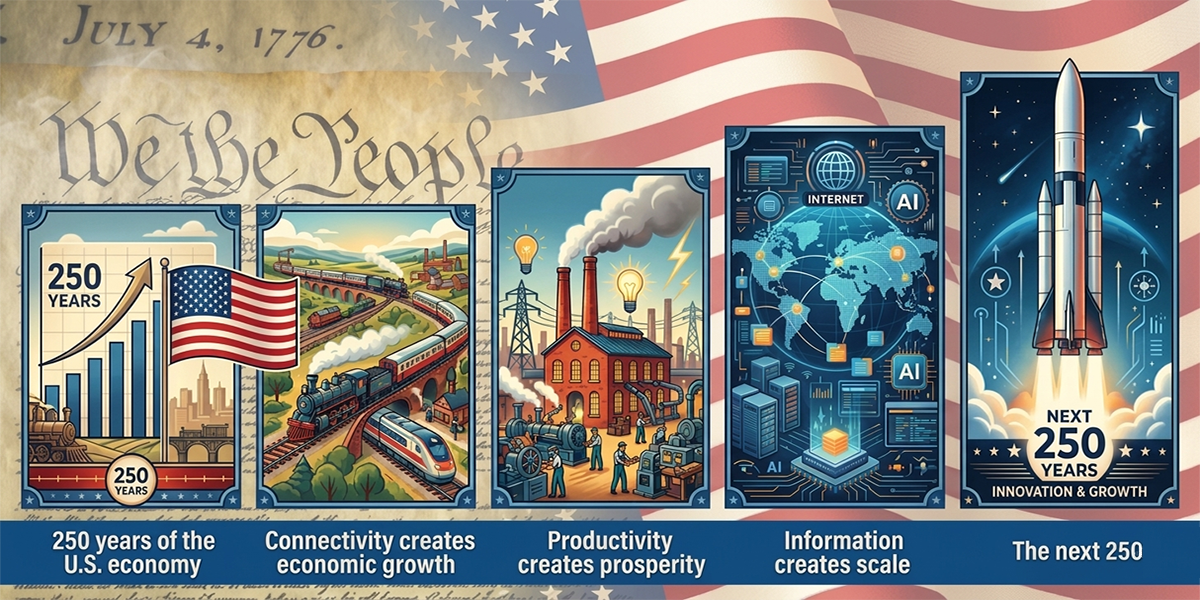
Each month, we invite clients to spend a few minutes reading our newsletter to build their investor IQ. July’s edition of Timely Topics celebrates America’s 250th anniversary with a walk through its economic history of innovation and growth.Each month, we invite clients to spend a few minutes reading our newsletter to build their investor IQ. July’s edition of Timely Topics celebrates America’s 250th anniversary with a walk through its economic history of innovation and growth.
- 250 years of the U.S. economy
- Connectivity creates economic growth
- Productivity creates prosperity
- Information creates scale
- The next 250
- Where will the stock market go next?
250 years of the U.S. economy
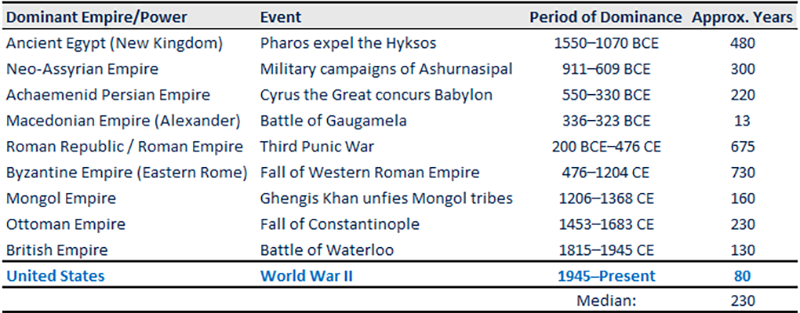
To put the past 250 years into perspective, it helps to adopt a longer historical lens. Many of history's dominant empires maintained economic, military, and cultural leadership for several centuries. If those examples are any guide, a 500-year horizon may not be unreasonable. Moreover, if America's era as the world's leading superpower is measured from the conclusion of World War II rather than from its founding in 1776, the United States may still be in the early stages of its global leadership story.
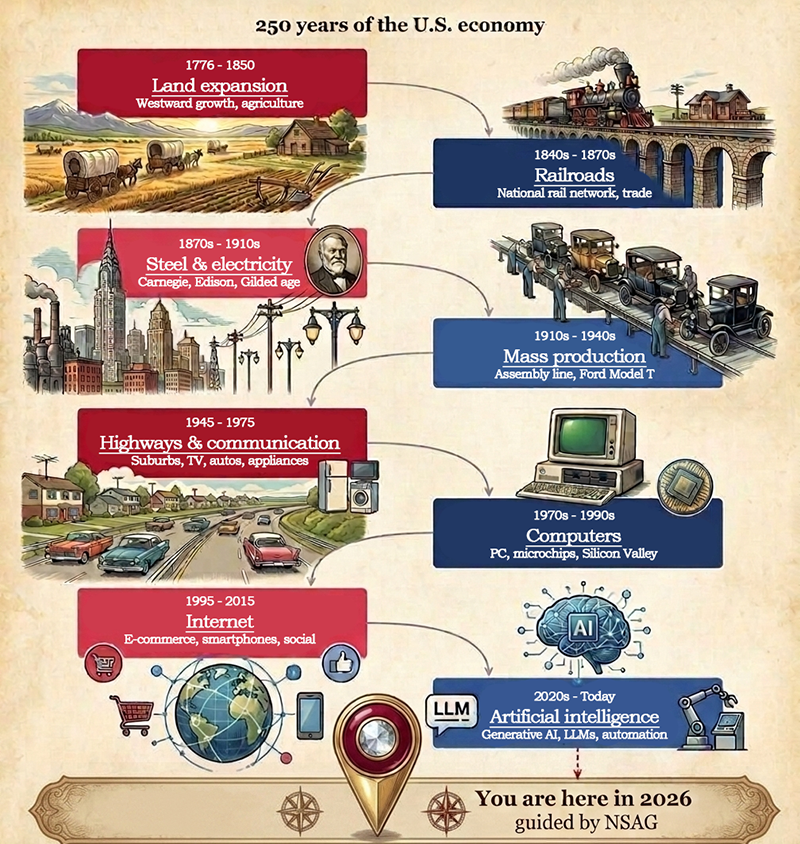
Over the past 250 years, the U.S. economy has been shaped by a series of transformative productivity revolutions, each building upon the last and expanding the nation's capacity to create wealth. The journey began with land expansion and agriculture in the late 18th and early 19th centuries, as westward growth turned a small collection of coastal states into a continental economy. Railroads followed, connecting distant regions into a unified national market and dramatically lowering transportation costs. By the late 1800s, advances in steel production and electricity fueled the Industrial Revolution, helping America emerge as the world's leading industrial power. The early 20th century then ushered in the era of mass production, where assembly lines and manufacturing innovations made automobiles and consumer goods affordable to millions of households.
Following World War II, the construction of highways, suburban expansion, and the rise of consumer spending powered decades of economic growth and rising living standards. The next major leap came from computers and microchips, which laid the foundation for the digital economy and transformed how businesses operated. The internet accelerated this trend, connecting people and commerce on a global scale while creating entirely new industries and business models. Today, the United States stands at the beginning of another potential economic transformation driven by artificial intelligence. While the technologies have changed dramatically over time, from farms and railroads to semiconductors and AI, the common thread throughout America's economic history has been innovation. Each generation discovered new ways to increase productivity, and those gains ultimately translated into stronger economic growth, higher corporate profits, and greater long-term wealth creation.
Yet this journey was far from smooth. The United States endured the Civil War, the Panic of 1873, the Great Depression, two World Wars, the inflation crisis of the 1970s, the Dot-Com bust, the Global Financial Crisis, and the COVID-19 pandemic. At various points, many feared that America's best days were behind it. Economic growth did not occur in a straight line; it advanced through cycles of expansion and contraction, optimism and uncertainty. Entire industries disappeared, new competitors emerged, and technological disruptions reshaped the workforce. Looking at any single decade, the future often appeared unclear. Looking across centuries, however, a different pattern emerges.
The lesson of the past 250 years is that growth has been compounding rather than linear. Each productivity revolution built upon the foundations created by previous generations, allowing the economy to recover from setbacks and reach new levels of prosperity. Railroads amplified the benefits of land expansion, electricity enhanced industrial production, computers accelerated business productivity, and the internet connected the global economy in ways previously unimaginable. The result is that despite countless recessions, crises, and geopolitical conflicts, the long-term trajectory of the U.S. economy has remained upward. For investors, this serves as a powerful reminder that wealth is often created not by avoiding every period of volatility, but by remaining invested in the enduring forces of innovation, productivity, and human progress that have driven economic growth for more than two centuries.
Connectivity creates economic growth
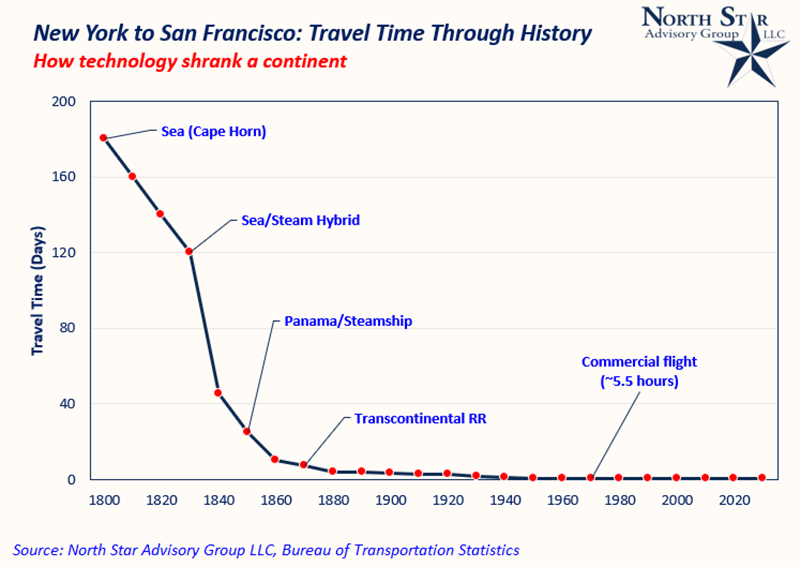
In the earliest days of America’s founding, the country was essentially a collection of local economies. Transportation was painfully slow, moving goods over land was expensive, farmers only sold good locally, and most Americans lived within a couple miles of where they were born. A shipment from Ohio to New York could cost more than a shipment across the Atlantic Ocean.
Before railroads, we had steamboats, the Erie Canal, and improving roads. These projects proved one thing: transportation costs matter. As transportation costs came down, trade increased, land values rose, and economic specialization emerged. These outcomes laid the foundation for the U.S. rail network.
In 1840, there was around 3,000 miles of rail track laid. By 1860, that number had 10x’d to around 30,000 and then 6x’d again to around 200,000 in 1900. Throughout the growth of the rail network, America transformed from a collection of local economies into a national economy. Grains from the Midwest could be efficiently shipped to western cities, factories on the east coast could source raw materials easily, and labor could move quickly around the country to where it was needed.
Despite this period of innovation, nothing was perfect or linear. There were various struggles that arose from the massive economic expansion. Labor conflicts over working conditions, child labor, and long hours occurred constantly. Westward expansion displaced many native American lands and communities, and large railroad companies had outsized influence on communities, eventually leading to early antitrust movements. In addition to these struggles, The Civil War occurred right in the middle of this massive revolution. Many historians credit a large portion to the North’s victory to the fact that northern states had more rail infrastructure. Troops could move faster, supplies moved faster, and more efficient logistics existed due to the infrastructure. When the war ended in 1965, track laying exploded even further.
Railroad companies were America’s first great growth stocks. Seems funny to say given how we currently think about growth investing in 2026, but these companies arguably had equal or greater impact on the future of America at the time. The railroad revolution attracted massive speculation, new investors, and huge capital inflows. Investors believed that railroads would change everything. They were right, but investing was still not easy. The Panic of 1873 was one of the worst financial crises in American history. Over-estimated short-term demand coupled with an overbuilt infrastructure and excessive leverage led to a deep recession, banking failures, and many railroad bankruptcies. Stocks fell by close to 50%.
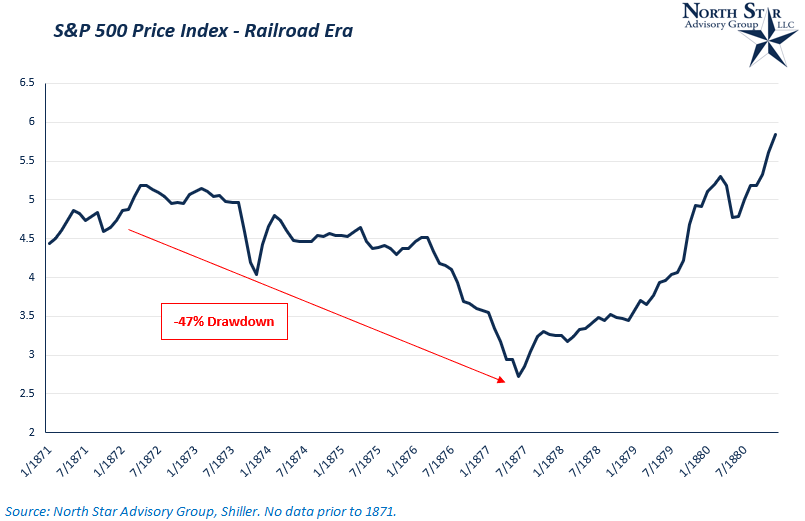
The railroad revolution demonstrates a pattern that would repeat throughout American history. Transformative innovations create enormous opportunities, but they also generate speculation, financial bubbles, labor disruptions, political conflict, and periods of painful adjustment. Yet over time, productivity gains tend to endure long after the setbacks fade. Railroads connected a continent, expanded markets, accelerated commerce, and laid the foundation for America's emergence as an industrial superpower. The investors who focused on the long-term transformation rather than the short-term turmoil were ultimately rewarded.
Productivity creates prosperity
If the railroad revolution turned America into a national economy, electricity and mass production laid the foundations for the modern economy. Before Edison invented the lightbulb in 1879 and early electric companies of the 1880’s scaled up, factories relied on steam power, water wheels and centralized mechanical shafts. Factories had to be built near power sources, machines needed to be arranged around the central drive system, and productivity gains were limited. As power grids, electric lighting, and electric motors continued to improve and gain adoption, the widespread impacts were massive. Factories were productive for longer, safer, more efficient, and many new industries were born.
Mass production capabilities changed everything. Henry Ford and the Model T are the best example of productivity gains from this era. When Ford pioneered the assembly line, Model T production time fell from roughly 12 hours to 90 minutes. Costs fell dramatically, volumes increased, and many new and old products became more accessible to everyday Americans. We compare electricity and mass production to today’s AI revolution because both technologies are being used to push every sector and industry forward. While electrification of the economy had massive impacts on businesses, it also had a massive impact on the quality of life of everyday citizens. Cars, radios, vacuums, refrigerators, etc. all made life easier for Americans. It is widely argued that this revolution created the middle class in America.
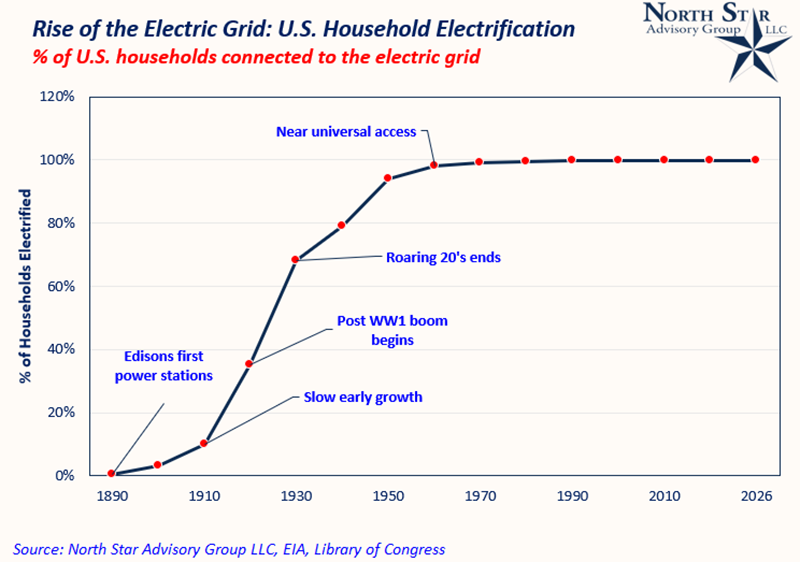
In the early 1900’s, new titans were born such as Standard Oil, U.S. Steel, General Electric, and Ford. Investors began pouring capital into utilities, manufacturing, consumer goods, and automobiles. America’s stock market expanded alongside industrial growth and productivity. The adoption and expansion of these new technologies was pushed forward by World War I, and the post-war boom led to the first modern bull market, the roaring 20’s (1920 – 1929). Rapid productivity growth, technology optimism, and new consumer products led to surging stock prices. From 12/1920 through 09/1929, stocks increased (S&P 500) by a total of 360% (~18.5% annualized).
Of course, what followed this tremendous bull market was the worst financial crisis in U.S. history. Investors had been using debt to buy more and more stocks on margin throughout the 1920s. When buyers stopped showing up in late 1929, the overleveraged stock market bubble began popping. Without deposit insurance, Americans rushed to pull their money out of the banks who had leveraged their deposits to invest. When they showed up to find that their dollars had evaporated, panic set in. While the market fell apart, a series of bad decisions led to even worse conditions. The newly founded Federal Reserve began tightening monetary policy (restricting and not injecting capital into the system), U.S. leaders passed the Smoot-Hawley Tariff act which led to decreased global trade, and the “Dust Bowl” ruined many farmer’s crops.
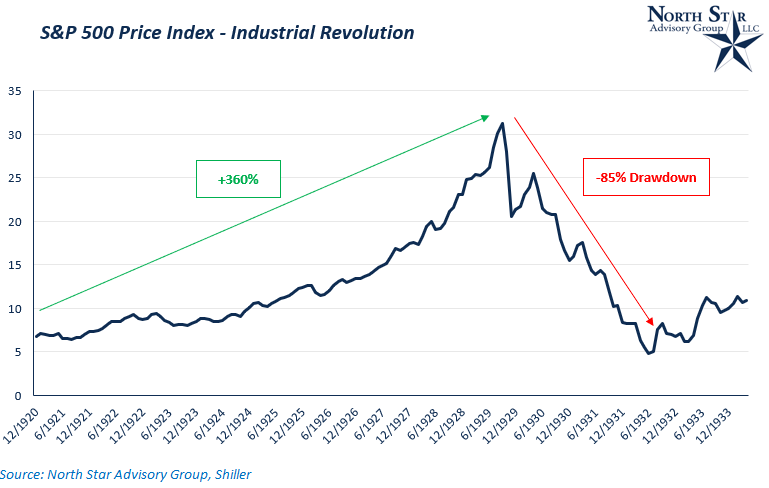
When analyzing this period, you’ll notice a similar pattern that emerged during the railway boom; Innovation -> Speculation -> Crisis -> Adaptation -> Long term wealth creation and productivity. While the world was falling apart in the late 1920’s/early 1930’s, the underlying themes of productivity gains continued to sustain themselves. This led us into becoming a global economic superpower and innovator and also likely allowed us and the allies to claim victory during World War II.
Information creates scale
If railroads connected America and electricity transformed production, the digital revolution transformed information. Just as electricity became a foundational technology in the early 1900s, semiconductors became the foundational technology of the late 20th century. The digital revolution was built on the foundational chip companies of the 1970’s which included Intel, IBM, and Texas Instruments. Next came personal computing companies of the 1980’s and 1990’s. Enter Microsoft, Apple, and Dell. Digital records, spreadsheets, databases and software made businesses dramatically more productive.
In the early days of the digital revolution, the connectivity piece was missing. Businesses had more and more information without a great way of sharing that information. If railroads connected cities, the internet connected people and businesses. Companies like Cisco, Microsoft, eBay, Yahoo, and Amazon ushered in the internet portion of this revolution. As information became digitized, that digitized information was now being shared. Scale became global, marginal costs fell, and globalization emerged. Again, like any other period, innovation was not linear or perfect. Data ownership, social media addiction, misinformation, and cyber-attacks are all issues that many Americans deal with to this day.
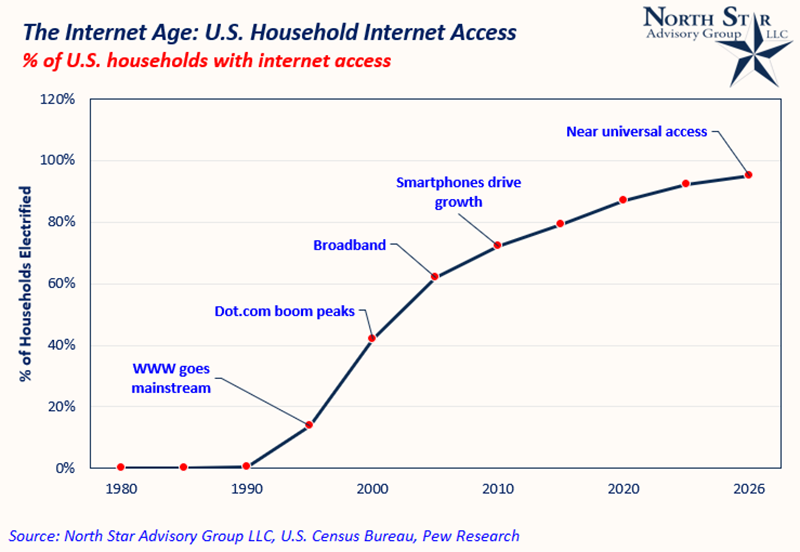
With any economic revolution, we see a pattern that conflict tends to breed more innovation; the Civil War was influenced by the railways, the World Wars were influenced by mass production capabilities, and the early semiconductor innovations of the 70’s were largely influenced by the Cold War. As the west was in an innovation race with the east, defense spending surged, and the technologies that were developed for military and aerospace applications eventually powered personal computers and the internet.
Internet companies began injecting capital into companies providing internet platforms and digital infrastructure. In their eyes, the internet will change everything. Just like with the railways, these investors were right in the long run, but over-estimated short-term demand, overbuilt infrastructure, low profitability, and mania surrounding valuations led to another major market bubble known as the dot.com crash. From 08/1995 through 09/2000, the S&P 500 rose by 166% before shedding 43% when the bubble burst. A few years later, the Global Financial Crisis rocked stock markets, and the S&P 500 gave up all of its dot.com recovery and more. While the GFC was not linked to technology speculation, innovation continued to grow and expand despite market turbulence. Cloud computing, mobile devices, social media, e-commerce, and streaming are just a few examples of products which came post dot.com and GFC.
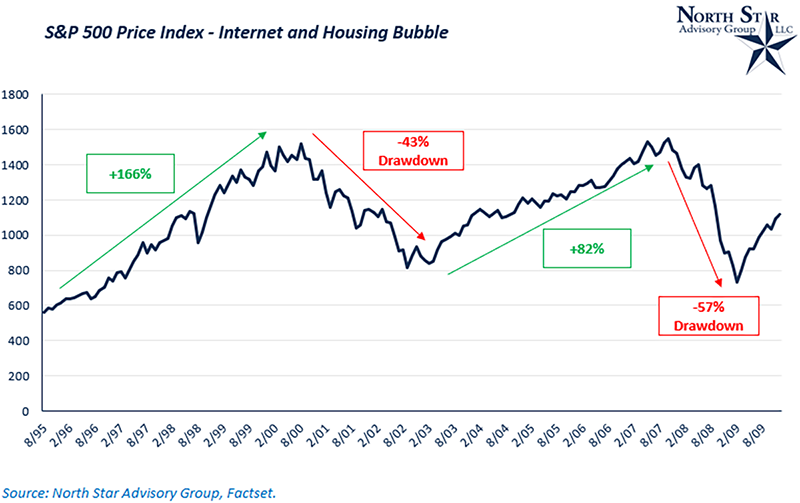
The 1990’s and early 2000’s show a pattern similar to previous eras; Innovation -> Speculation -> Crisis -> Adaptation -> Long term wealth creation and productivity.
The next 250
As we complete our walk through America’s economic history, two main themes appear to be consistent:
- Innovation leads to productivity gains which leads to economic growth
- Economic growth is non-linear
Whether we are analyzing the railway boom, the industrial revolution, or the digital age, these themes keep re-emerging. Within each revolution, recessions, bubbles, and wars/conflicts are always on the schedule at some point in time. Despite these headwinds, innovation powers through. You can see this illustrated below as we combine the timeline in market terms:
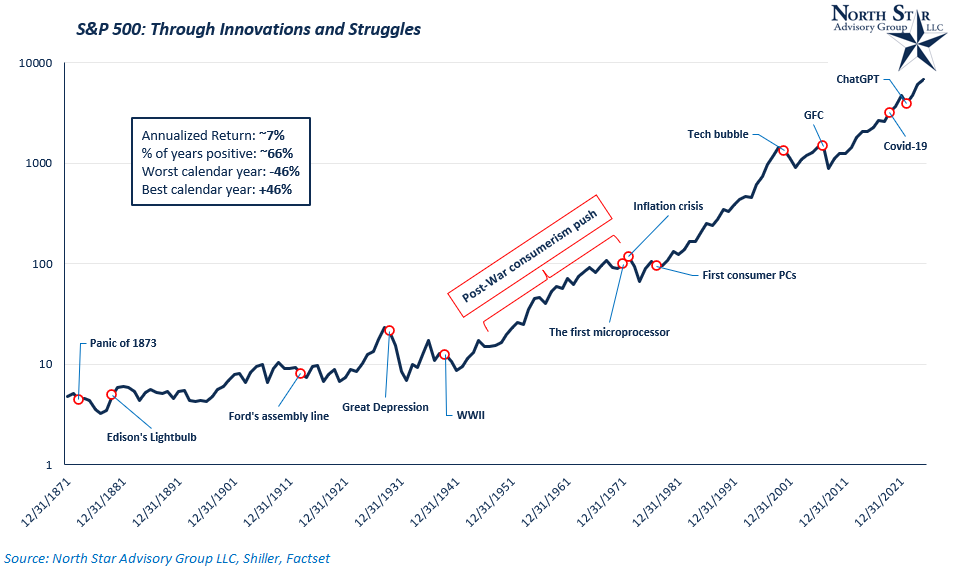
As we look forward to 2030, 2040, 2050 and beyond, what are the next frontiers? As of 2026, we find ourselves in the middle of a new economic revolution in the form of artificial intelligence. What current products or industries will become the next horse traders in Detroit, 1909 at the hands of this technology? What new industries and jobs are born and what might be the next great technology after AI?
The odds most likely favor Space commercialization at this time given the hype and interest around SpaceX’s IPO on 6/12/2026. Whether it’s space, quantum computing, or something different, we know that the next frontier will likely rhyme with revolutions of the past. A breakthrough technology emerges, capital floods the opportunity, markets experience euphoria and setbacks, society adapts to the new technology, and productivity gains endure.
Where will the stock market go next?
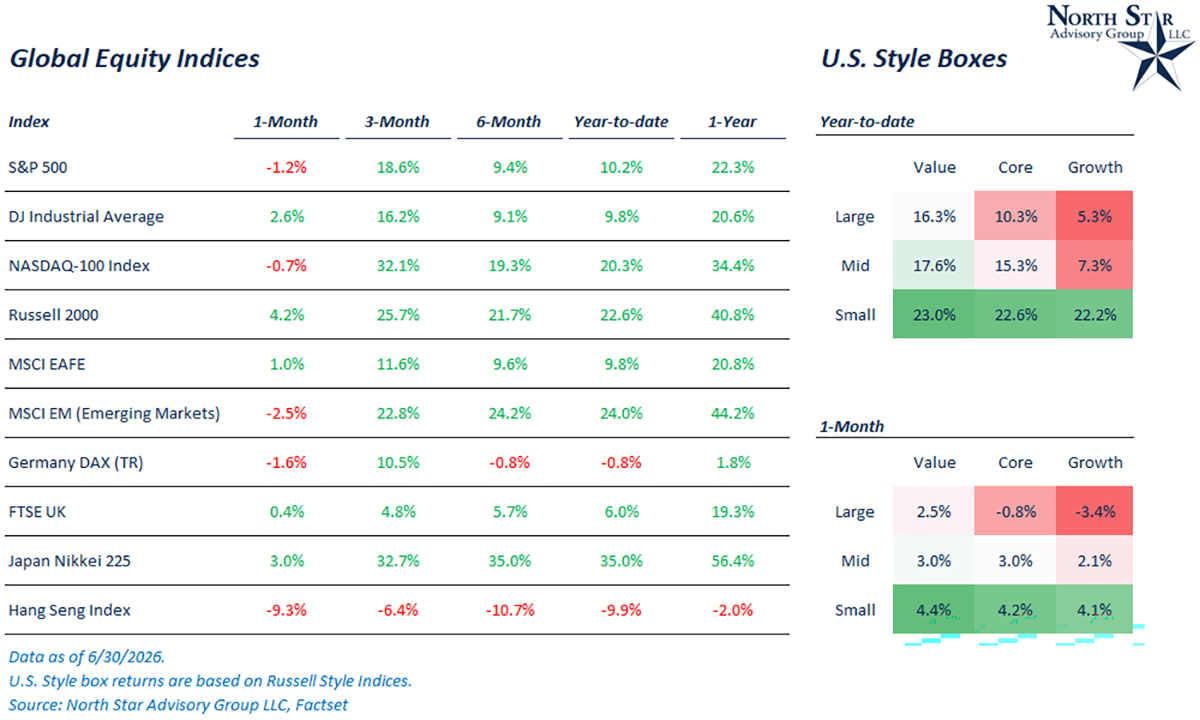
Six months into the year, investors with stock portfolios that are diversified across geographies and market sizes continue to outperform investors who are concentrated in U.S. Large Cap (S&P 500). As of 6/30/2026, the S&P 500 Index is up 10.2%, the MSCI EAFE index (non-U.S. developed) is up by 9.8%, the MSCI Emerging Markets Index is up 24%, and the Russell 2000 (U.S. small cap stocks) is up 22.6%. Just like 2025, diversification has led to both lower volatility and higher returns at the mid-point of 2026.
Diving deeper into the S&P 500’s first half gain, positive performance has been concentrated in semiconductors and semi-cap equipment (“semis”), a component of the broader technology sector. Semis are positive by ~100% through the first half of the year, as measured by the PHLX Semiconductor Index. This one industry has contributed ~70% of the S&P 500’s total return so far this year.
As we look ahead at the second half of the year, we expect returns on the S&P 500 Index to continue to be dictated by sentiment around the AI investment cycle given the concentration of the companies who are exposed to this trend. Clearly, these companies have seen very strong earnings growth, but the market appears to be grappling with the sustainability of the overall investment trend as volatility picked up steam in the second half of June. If hyperscalers reconfirm or increase their capital expenditure estimates during Q2 earnings season, we expect to see more strength in semiconductor names and more weakness within the hyperscalers as we move forward.
We are passionately devoted to our clients' families and portfolios. Contact us if you know somebody who would benefit from discovering the North Star difference, or if you just need a few minutes to talk. As a small business, our staff appreciates your continued trust and support.
Keep sending your questions for a chance to be featured in next month’s Timely Topics.
Best regards,


Mark Kangas, CFP®
CEO, Investment Advisor Representative


Brian Duffield, CFA®
Co-Portfolio Manager & Market Strategist